Your portfolio is a work of art. Your execution is flawless. But when a high-net-worth homeowner in London, Dubai or Bangalore opens Google and searches for a luxury interior designer – your studio is a ghost. Someone else appears. Someone else gets the call. Someone else closes the $150,000 project.
This is not a design failure. It is a system failure.
After auditing hundreds of interior design and architecture websites globally – from studios in Mumbai and Delhi to firms in New York, Toronto, London and Dubai – we have identified the same critical errors appearing every single time. These are not minor tweaks. They are fundamental gaps that suppress your visibility, leak premium client inquiries and hand your competitors the ranking you deserve.
With over a decade of performance marketing experience across Google and Meta, working exclusively with interior design and architecture studios worldwide, here is the complete protocol to identify and fix every one of them.
Why SEO Is Non-Negotiable for Interior Design Studios in 2026
Interior design clients do not just ask friends for referrals anymore. They search Google. They compare portfolios. They read expert content. They watch project walkthroughs on YouTube. And they make their hiring decision before they ever contact single designer.
The global interior design market is projected to reach $175 billion by 2030. The studios capturing the largest share of that market are not necessarily the most talented. They are the most visible. SEO builds that visibility permanently – unlike paid ads that stop the moment your budget does.
If your studio is not ranking on page one of Google for your core services, you are handing $50,000 to $250,000+ projects to your competitors every single day. Here is exactly why that is happening and the precise protocol to fix each mistake.
Mistake 1: Targeting Keywords Your Clients Are Not Actually Searching
This is the most common and most damaging SEO mistake interior designers make. Most studio websites are optimised around keywords like interior design ideas or home decor inspiration – terms that attract millions of searches from students, renters and DI enthusiasts who will never commission a $50,000 project.
Your actual clients – high-net-worth homeowners planning a full renovation, property developers commissioning a luxury fit-out, business owners designing a premium commercial space in New York, Toronto, London or Dubai – are searching with intent and specificity. Matching that intent is the entire foundation of SEO that actually converts.
What High-Net-Worth Interior Design Clients Actually Search For
Think like your premium client. They are not searching interior design ideas. They are searching:
- luxury interior designer in [their city]
- high-end residential interior design firm
- interior designer for villa renovation
- best architecture studio for home interiors
- commercial interior design for office fit-out
- how much does a full home interior design cost
- interior designer for new construction project
- luxury home renovation designer near me
The person typing luxury interior designer in Dubai is ready to hire. They have a $100,000 to $500,000 budget. They have a project timeline. They need a firm right now. If your website is not optimised for these phrases, that client goes to whoever is.
The Fix: Use Google’s Own Free Tools to Build Your Keyword Strategy
You do not need expensive software to start. Google gives you everything you need for free. Use these official tools:
Google Keyword Planner
Link: Click Here
Description: Free inside Google Ads. Shows exact monthly search volumes for every keyword you want to target. Start here before building any page on your website.
Google Trends – Interior Design
Link: Click Here
Description: See which interior design search terms are rising globally right now. Filter by country and city to find exactly what your target markets in the USA, Canada, UK, India and UAE are searching for in real time.
Google Search Console
Link: Click Here
Description: Shows exactly which keywords people are already using to find your site. Free and essential. Connect this to your website today if you have not already done so.
People Also Ask – Live Google Search
Link: Click Here
Description: Search your core term and read every question in the People Also Ask section. These are real questions from real clients. Every single one is a potential blog post or service page.
Open Google Trends right now and search interior designer filtered to your target country. Switch to the Related Queries tab. You will see exactly what premium clients are searching for in real time. Build your keyword list from live data, not guesswork.
Mistake 2: Your Portfolio Images Are Destroying Your Page Speed
Interior design websites are image-heavy by nature. And that is exactly why this mistake is so widespread and so damaging. You invest in professional photography, upload every image at full resolution and build a stunning portfolio that takes 12 seconds to load.
Google measures page speed as a direct ranking factor. A page loading in over 3 seconds loses 53 percent of mobile visitors before they even see your work. Google’s Core Web Vitals algorithm actively penalises slow-loading pages by pushing them down the search results. We have audited interior design websites with a single portfolio page carrying over 40MB of images. The entire page should be under 3MB total. That gap is directly suppressing your Google rankings every single day.
The Fix: Run Your Site Through Google’s Own Speed Test Right Now
Google has published exactly what it measures and what good performance looks like. Use these official tools:
Google PageSpeed Insights
Link: Click Here
Description: Paste your website URL here and Google scores you speed out of 100. It tells you exactly what to fix and in what order of priority. A mobile score below 70 means your rankings are being actively suppressed by speed alone.
Core Web Vitals – Official Google Guide
Link: Click Here
Description: The three specific speed metrics that directly affect your search ranking. Read this to understand exactly what Google is measuring on your site.
Google’s Image Optimisation Guide
Link: Click Here
Description: Official guidance on how Google reads, crawls and ranks your images in both standard and image search results. Essential reading before you upload another portfolio photo.
Five Image Fixes That Improve Speed and Rankings Immediately
- Convert all images to WebP format – same visual quality at 30 percent smaller file size than JPEG
- Compress every image using ShortPixel or Smush before uploading to Website – both have free plans
- Never upload an image larger than its display size – a thumbnail displayed at 400px does not need to be a 4000px file
- Enable lazy loading in WordPress so images below the fold only load as the user scrolls down the page
- Add descriptive alt text to every single image using your target keywords naturally – this improves both Google search ranking and Google Images ranking simultaneously
Mistake 3: Ignoring Google Business Profile Completely
When a high-net-worth client in your city searches luxury interior designer near me the first results they see are not websites. They are Google Business Profile listings on Google Maps. Three listings. Right at the top of the page. Before every single organic website result.
Most interior design studios either have no Google Business Profile at all or have one that was set up years ago and never touched since. An incomplete or unoptimised profile means you are completely invisible for every local search – and local searches are where your highest-intent, highest-budget clients come from because they are searching within your service area with a specific $50,000 to $250,000+ project already in mind.
The Fix: Follow Google’s Own Step-by-Step Setup Guide
Everything you need to set up and optimise your Google Business Profile correctly is published directly by Google. Use these official resources:
Create or Claim Your Google Business Profile
Link: Click Here
Description: Start here. Claim your free listing in under 10 minutes. This is the single highest-return free action available to any interior design studio right now.
Official GBP Setup Guide – Step by Step
Link: Click Here
Description: Google’s complete instructions for setting up your profile correctly from scratch. Follow this exactly.
How to Add Project Photos to Your Profile
Link: Click Here
Description: Profiles with photos receive 42 percent more direction requests according to Google’s own data. Here is exactly how to add and optimise yours.
How to Get and Manage Client Reviews
Link: Click Here
Description: Reviews are a direct local ranking factor. This is Google’s official guide on how to request and manage them properly without violating any guidelines.
GBP Content Policy and Guidelines
Link: Click Here
Description: Read this before optimising so your listing is never suspended for a policy violation. This takes 5 minutes and protects everything you build.
Mistake 4: Your Website Has No Location-Specific Pages
If you serve clients in multiple cities or want to attract premium clients from specific global markets, you cannot achieve this with a single generic homepage. Google needs dedicated location pages to rank you for location-specific searches in each market.
A studio based in Mumbai targeting Pune, Bangalore and Delhi needs individual pages for each city. A firm in London targeting Kensington and the Home Counties needs separate pages. A Dubai studio targeting Abu Dhabi and Riyadh needs the same treatment. A New York firm targeting clients across the East Coast needs dedicated pages for each major market. Each page needs genuinely unique content – not just the city name swapped in the headline.
The Fix: Follow Google’s Official Guidance on Location Pages
Google’s Guide to Multi-Location Businesses
Link: Click Here
Description: Official Google guidance on how to correctly structure your presence across multiple locations and markets.
Google’s Doorway Pages Policy
Link: Click Here
Description: Read this before building location pages. Understand exactly what Google rewards versus what it penalises so you build pages that rank and not pages that get filtered out.
Each location page must include the city name in the page title, H1 heading, meta description and URL slug. Write genuinely unique content for each page. Reference local projects you have completed, specific neighbourhoods you serve and the type of clients in that market. Include a Google Maps embed and local testimonials wherever possible. This is how interior design studios expand from local to global – not through a single homepage trying to serve everyone but through a precise network of targeted pages each owning a specific geographic search.
Mistake 5: Your Website Content Speaks to Everyone and Converts Nobody
This is a positioning problem that becomes an SEO problem directly. Google’s algorithm in 2026 does not just rank for keywords – it ranks for topical authority, content depth and user engagement signals. If visitors land on your website and leave within 8 seconds because the content does not speak to them specifically, Google registers that as a poor quality experience and reduces your ranking accordingly.
Interior design websites across the globe are full of copy like We create beautiful spaces that reflect your personality. That
sentence means nothing to a high-net-worth client in Toronto or Dubai evaluating three studios for a $200,000 renovation project. It gives Google nothing specific to rank. It gives your visitor no reason to stay. It converts nobody.
The Fix: Write to the Standard Google Uses to Rank Content
Google has published the exact quality standard it uses to evaluate whether your content deserves to rank. Read each of these official documents:
Google’s Helpful Content Guidelines
Link: Click Here
Description: The exact framework Google uses to evaluate whether your content deserves to rank above your competitors. This is not optional reading.
Google’s E-E-A-T Framework
Link: Click Here
Description: Experience, Expertise, Authority and Trust. The four factors Google uses to evaluate content quality. This is how you position DGC as a global expert authority.
Google SEO Starter Guide
Link: Click Here
Description: The single most important document Google has ever published for website owners. Read this in full. It is free and it is the official rulebook.
Google Search Essentials
Link: Click Here
Description: Google’s complete guide to what makes a website eligible to rank well in 2026. The non-negotiable foundation every studio website must meet.
Your content must speak directly to the specific fears, questions and ambitions of your premium client. A high-ticket residential client in London or New York wants to know: How will you manage my project timeline and budget? Can I see completed projects at my investment level? Have you worked with clients in my situation before? What does the process look like from first meeting to final delivery? Answer those questions explicitly on every relevant page. That is what ranks in 2026. That is what converts.
Mistake 6: No Blog Strategy Means No Long-Term Organic Growth
Your core service pages can only rank for so many keywords. Long-term compounding organic traffic – the kind that brings premium clients to you without ongoing ad spend – comes from a consistent blog strategy targeting the exact questions your ideal clients are searching before they are ready to hire.
A homeowner in Toronto planning a $300,000 renovation 6 months from now is searching how much does full home interior design cost and what to expect from an interior designer consultation right now. If your blog answers those questions and ranks for those searches, that client finds you first – before any competitor – and they arrive at your website with built-in
trust because you already helped them.
As we broke down in detail in our post on Why Boosting Posts Fails [Read Full Blog], a consistent content and blog strategy is the long-term engine that replaces expensive daily ad spend with permanent, compounding visibility on Google that works for you 24 hours a day.
The Fix: Use Google’s Own Tools to Find Exactly What to Write About
Google Trends – Interior Design Topics
Link: Click Here
Description: See which interior design topics are trending globally right now. Filter by USA, Canada, UK or UAE to find local content opportunities your competitors are completely missing.
Google People Also Ask – Real Client Questions
Link: Click Here
Description: Every question in this box is a real search from a real potential client. Search any topic relevant to your studio and build your entire editorial calendar from these actual queries.
Google’s Structured Data Guide for Articles
Link: Click Here
Description: How to mark up your blog posts so Google fully understands them and features them in rich results and featured snippets at the top of the page.
High-intent blog topics that consistently drive qualified, high-budget traffic to interior design studio websites across global markets:
- How to choose the right interior designer for your home renovation
- What does a full home interior design project cost in [your city]
- Luxury interior design trends for 2026
- How to brief an interior designer – what to prepare before your first meeting
- Questions to ask before hiring an interior design studio
- What is the difference between an interior designer and an interior decorator
- How long does a full home interior design project take from concept to final delivery
- How to find a luxury interior designer in [New York / London / Dubai / Toronto] – create individual posts per city you want to rank in
Each of these topics captures a different stage of the buyer journey. Together they build a content network that brings qualified, high-intent traffic to your website consistently across every market – and every post feeds visitors toward your service pages and strategy call booking.
Mistake 7: No Internal Linking Strategy Between Your Pages
This is the most overlooked technical SEO mistake interior designers make globally – and one of the easiest and fastest to fix. Internal linking is the practice of connecting your own pages to each other within your content. It does two critical things simultaneously: it helps Google discover and understand all your pages, and it passes SEO authority from your high-traffic pages to the pages you most want to rank.
Most interior design websites are essentially isolated silos. The homepage does not link to case studies. Blog posts do not link to service pages. The about page does not link to the portfolio. Google crawls your homepage, finds no paths deeper into your site and leaves. Your other pages remain invisible in search results regardless of how good the content on them is.
The Fix: Google’s Official Guidance on Links and Site Structure
Google’s Guide to Links and Rankings
Link: Click Here
Description: How Google uses links to discover pages and distribute ranking authority across your entire website. Read this to understand exactly how authority flows between your pages.
Google’s Site Structure Guide
Link: Click Here
Description: Official Google guidance on how to structure your website so it is fully crawlable, fully indexable and accumulates authority efficiently across all pages.
The Internal Linking Rule for Every Single Page You Publish
- Every blog post links to at least 2 relevant service pages using keyword-rich anchor text – not click here but phrases like interior design lead generation or SEO for architecture studios
- Every service page links to at least 2 relevant case studies and related blog posts
- Every case study links back to the service page for that specific project type
- Your about page links directly to your portfolio and your strategy call booking page
- Your homepage links to your top 5 most important pages with descriptive keyword-rich anchor text
Mistake 8: You Have No International SEO Infrastructure
This is the mistake that specifically costs interior design studios their global reach – and it is almost never discussed in the industry.
If you are a firm in Delhi wanting to attract clients in Mayfair London, a studio in Mumbai targeting Dubai and Abu Dhabi, or an architecture practice in Bangalore reaching New York and Toronto – Google needs to see that your website is technically prepared for international traffic. Without this infrastructure in place, your content is invisible in those markets regardless of how strong your design work is and regardless of how well-written your pages are.
What International SEO Infrastructure Actually Means
International SEO for interior design studios operating across global markets involves three specific technical layers that most studios have never implemented:
- Hreflang tags – tells Google specifically which version of your content to show in which country and language so a client in London sees UK-relevant results and a client in Dubai sees UAE-relevant results
- Geotargeting settings in Google Search Console – explicitly signals to Google which countries and regions you are actively serving so it prioritises showing your pages in those markets
- Location-specific URL and content structure – dedicated pages per target market with country or city-specific content, pricing references and local context that Google can index and rank independently
The Fix: Google’s Complete International SEO Documentation
Google’s Official Hreflang Implementation Guide
Link: Click Here
Description: Official Google documentation on telling Google exactly which pages to show in which countries. If you are simultaneously targeting London, Dubai, New York and Toronto from an Indian studio, this is non-negotiable.
Google’s Multi-Regional and Multilingual Sites Guide
Link: Click Here
Description: The complete Google playbook for studios serving clients across multiple countries and regions. The full technical framework for global visibility.
International Targeting in Google Search Console
Link: Click Here
Description: Set your geotargeting preferences directly inside Search Console so Google knows precisely which markets you are serving and prioritises showing your pages there.
Free Hreflang Tag Generator by Aleyda Solis
Link: Click Here
Description: Free tool by one of the world’s leading international SEO experts. Generates the correct hreflang code for your specific combination of target markets. No technical knowledge required to use it.
Consider this: 56 percent of all Google searches globally are conducted in non-English languages. A luxury client in Dubai searches with UAE-specific intent. A premium homeowner in London searches with UK market context. A property developer in Toronto searches with Canadian market expectations. Without proper international SEO signals your studio is invisible to all of them – regardless of how strong your English-language SEO is and regardless of how premium your portfolio looks.
The studios winning $100,000 to $500,000+ projects across multiple global markets are not winning on design talent alone. They are winning because their websites are technically configured to be found in every market they want to serve. This is the infrastructure layer that separates a local studio from a globally recognised firm.
The Compound Effect: Fix All 8 and Watch What Happens
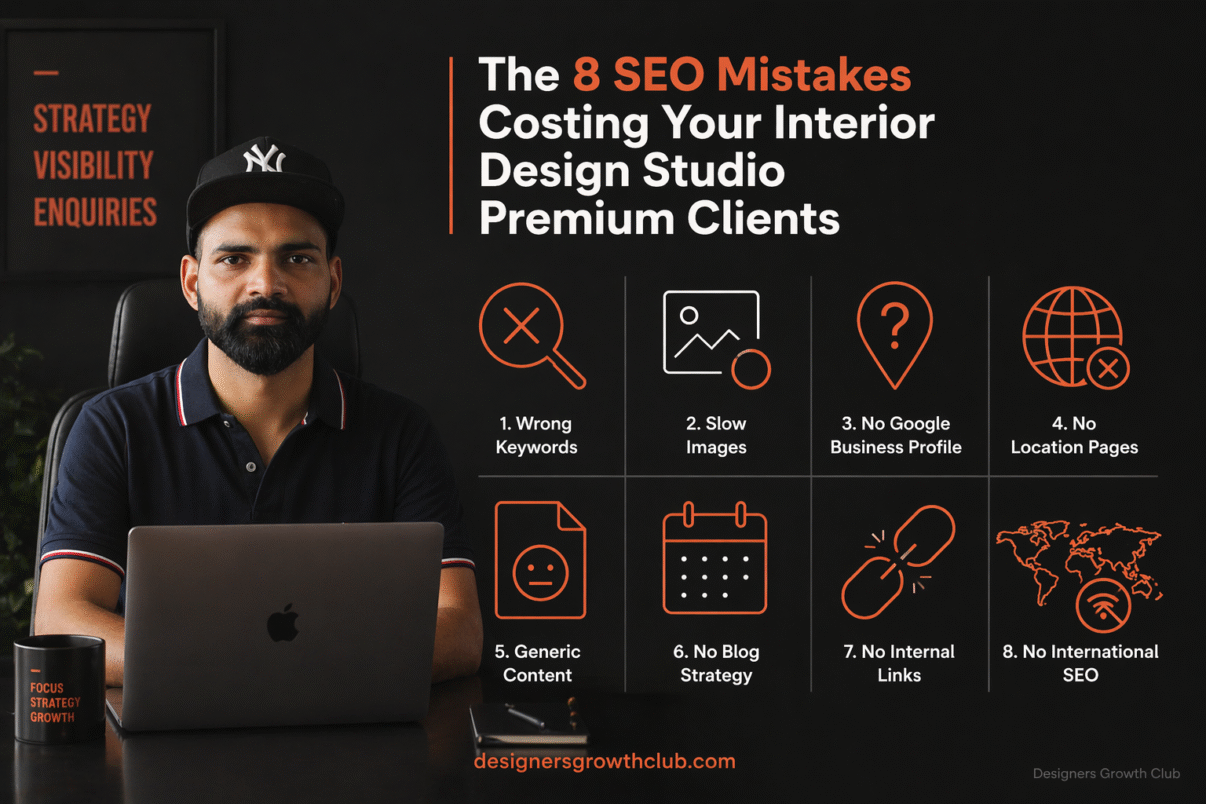
Every one of these 8 mistakes compounds negatively when left unfixed. Wrong keywords attract the wrong traffic. Slow images actively suppress your rankings. No Google Business Profile makes you invisible to every local high-intent search. No location pages make you invisible in every target market outside your home city. Weak generic content increases bounce rate which further reduces rankings. No blog means no new organic traffic growth month on month. No internal linking means Google cannot fully crawl or index your site. No international infrastructure means you are completely invisible to every global market you want to serve regardless of everything else you do.
Fix all 8 together and the compound effect works in the opposite direction. The right premium clients find you when they search in London, Dubai, New York, Toronto and Bangalore. Your content builds trust and authority before they even contact you. Your strategy call calendar fills with $50,000 to $250,000+ project inquiries from clients who found you on Google – without spending on ads to reach them.
SEO is not a one-time project. It is a permanent client acquisition system. When built correctly for an interior design studio it operates 24 hours a day, 7 days a week, in every market you want to serve – India, USA, Canada, UK, UAE and beyond.