
Marketing feels like an investment you are not ready for yet. We get it.
You watch agencies post case studies of designers closing $2 million projects. You see Instagram experts charging $1,500 monthly retainers. You read about studios spending $5,000 a month on Google Ads. And you wonder if growth is only possible with deep pockets.
It is not.
Before you spend a single dollar on an agency, before you commit to ad budgets, before you sign a marketing retainer – there are 11 powerful things you can do right now that will build the foundation of everything that comes next. This is the exact playbook we share with designers who reach out to us but are not yet at the stage where investing in Designers Growth Club makes sense.
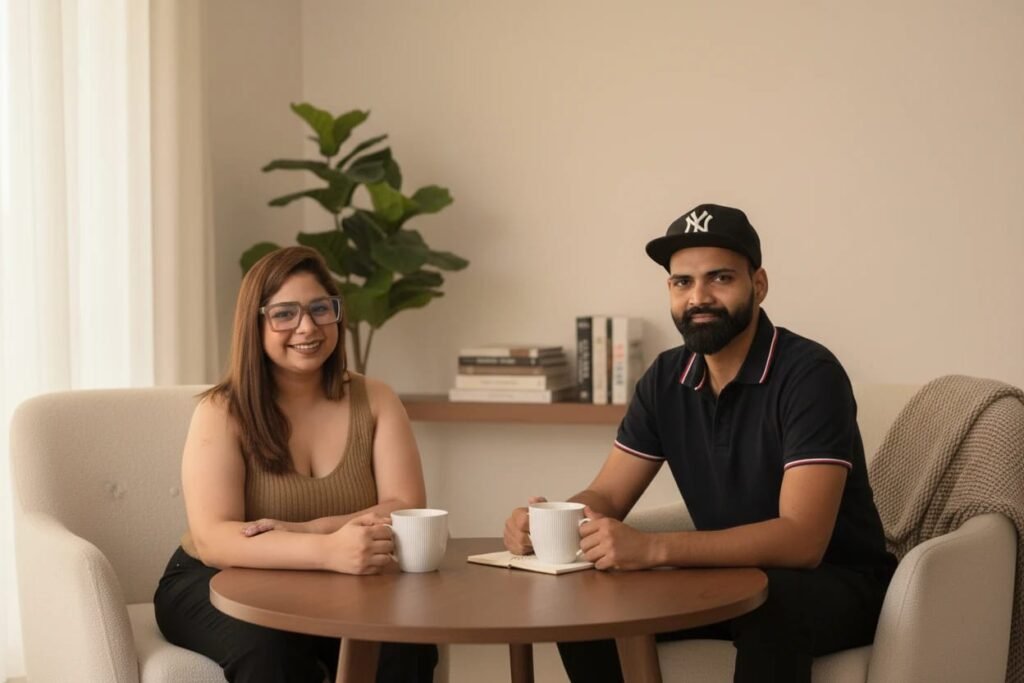
This is from both of us – Gunika, who spent 10+ years inside the interior design industry understanding exactly how high- et-worth clients think, and Tousif, who spent 10+ years building performance marketing systems across Google and Meta for lobal brands. Together we have audited hundreds of interior design studios worldwide – from Beverly Hills and Manhattan to London, Dubai and Mumbai.
These 11 actions are what separates the studios that eventually scale from the ones that stay stuck.
Read this in full. Implement what applies to you. And when you ARE ready to invest – you will multiply every dollar because the foundation is already in place.
Why Most Interior Designers Stay Stuck: The Investment Trap
Most interior designers we meet are caught between two extremes. On one side they refuse to spend anything on marketing – hoping referrals alone will scale them. On the other side they panic-spend on the first agency or ad campaign without any foundation in place – then blame marketing when it does not work.
The truth is simpler. Before any paid marketing makes sense, your foundation needs to exist. Your positioning needs to be clear. Your portfolio needs to be searchable. Your client communication needs to be sharp. Your local visibility needs to be claimed. Your content engine needs to be running.
Spend zero money. Spend serious time. Build the foundation first. That is exactly what these 11 actions do:
1. Define Your Niche With Surgical Precision
“Interior designer” is not a niche. “Residential interior designer for luxury homes in Manhattan” is. “Modern minimalist office interiors for tech startups in Austin” is. “Heritage home renovation specialist in Charleston” is. “Beachfront luxury villa designer in Miami” is.
The studios that scale fastest are not the ones serving everyone. They are the ones owning a specific corner of the market so completely that when a client thinks of that particular project type, only one name comes to mind. This applies whether you are in Los Angeles, London or Lucknow.
Gunika spent years inside the industry watching designers chase every project type. The ones who broke through were always the ones who said no to 70 percent of inquiries and focused on becoming the absolute best at 30 percent. Within 2 years that 30 percent paid 5x more per project than the 70 percent ever did.
How to Define Your Niche Today
- List the 10 best projects you have ever completed
- Find the common thread – client type, project size, style, location
- Write one sentence that captures it: “We design [project type] for [client type] in [location]”
- Use this sentence on your website, social media bio, business cards and every introduction
- Stop chasing projects that do not fit this sentence for the next 6 months
2. Optimise Your Google Business Profile Immediately
This is the single highest-return action available to any interior designer. It is completely free. It takes one hour to set up properly. And it makes you instantly visible to every high-intent client searching for designers in your area – whether that area is the Hamptons, Beverly Hills, Naples Florida or Westchester County New York.
When someone in your city searches “luxury interior designer near me” the first three results they see are Google Business Profile listings on Google Maps. Above every paid ad. Above every organic website. If you are not in those three slots you do not exist for that search.
The Free Setup Steps
- Go to Google My Business and claim your free listing in under 10 minutes
- Fill every single field – description, services, service areas, opening hours
- Upload minimum 15 high-quality project photos
- Rename every photo before uploading: luxury-living-room-design-manhattan.jpg not IMG_4521.jpg
- Ask every past client for a Google review – reviews are a direct ranking factor Post a weekly update sharing new projects, behind-the-scenes content or design tips
We covered this in detail in our previous post on the 8 SEO mistakes interior designers make that kill their Google visibility. A fully optimised profile can place your studio in the top 3 local results within weeks – without spending a single dollar.
3. Rewrite Your Instagram Bio to Convert Not Just Decorate
Your Instagram bio is the most important 150 characters of your entire online presence. Most designers waste this space on emojis, vague phrases like “creating beautiful spaces” or quotes that say nothing about what they do.
A premium client lands on your profile. They look at your bio. In 3 seconds they decide whether to keep scrolling or move to the next designer. That decision is made entirely from those 150 characters.
The Bio Formula That Actually Converts
Use this exact structure:
- Line 1: Who you serve – “Luxury interior designer for high-net-worth homeowners”
- Line 2: Where you serve – “New York | Miami | Los Angeles | Worldwide”
- Line 3: Specific outcome you deliver – “Turnkey luxury interiors that complete in 90 days”
- Line 4: Clear call to action – “DM ‘CONSULT’ to book your design call”
- Line 5: Trust signal or proof point – “Featured in Architectural Digest | 150+ projects delivered”
Add one link in your bio that goes to your website or WhatsApp Business. Not Linktree with 12 links. One link to the next action you want them to take. Follow @designers_growth_club where we break down exactly how successful interior designers structure their Instagram profiles for conversion.
4. Build a Portfolio Website Even If It Is Free
Instagram is rented land. Pinterest is rented land. Every social platform can change its algorithm tomorrow and suddenly your audience disappears. A website is your owned land. It is the single most important asset your business can have.
You do not need to spend $5,000 on a custom-built site. You can launch a clean, professional portfolio in one weekend for zero or near-zero cost.
Free or Near-Free Website Options:
- WordPress.com – Free plan with custom domain available
- Wix – Free templates designed specifically for portfolios
- Squarespace – 14-day free trial then $16 per month – the lowest entry cost for premium templates
- Notion – Build a beautiful portfolio site completely free using Notion pages
- Carrd – Single page portfolio for just $19 per year
Your Portfolio Site Needs Exactly 5 Pages:
- Home – Hero photo + one sentence about who you serve + call to action
- Portfolio – Best 8 to 12 projects with high-quality photos and short captions
- About – Your story, qualifications and why clients trust you
- Services – What you offer with starting price ranges if possible
- Contact – Phone, email, WhatsApp, Instagram and a simple inquiry form
That is it. Five pages. One weekend. Zero budget. You now own a professional online presence that works for you 24 hours a day.
5. Document Every Project on Social Media – Even the Process
Most designers only post the final reveal photo. The studios that grow fastest post the entire journey – the messy site visit, the material selection, the client confusion, the breakthrough moment, the installation chaos and finally the reveal.
Process content does three things that finished photos cannot. It shows your expertise in real time. It builds emotional connection with potential clients. And it gives you 30 pieces of content from a single project instead of just one final post. This is exactly why our Instagram carousels at Designers Growth Club hit hundreds of thousands of views – we show the entire system, not just the outcome.
What to Document on Every Single Project
- First site visit – take a video walking through the empty space
- Material selection – show mood boards, fabric samples, paint swatches
- Client meetings – share insights from the conversation without revealing private details
- Demolition and construction – the unglamorous reality of design work
- Site progress photos every week
- Behind-the-scenes problem-solving – what went wrong and how you fixed it
- Vendor coordination – share the network of artisans and craftsmen you work with
- Final installation day
- Reveal day client reaction
- After photos with detailed captions explaining design decisions
One project becomes 30+ pieces of content. You stop running out of things to post. Your audience watches your expertise unfold instead of just admiring the finished result. Use Buffer or Meta Business Suite to schedule a full week of these posts in one sitting – both have free plans.
6. Master the WhatsApp and DM Inquiry Conversation
Most interior design inquiries die in the first message. A potential client reaches out, the designer responds with “Hi, please share your requirements” – and the conversation ends right there.
The inquiry conversation is your entire sales process. Premium clients decide whether to engage you in the first 3 messages. How you respond determines whether you close a $50,000 project or lose it to your competitor.
The First Response Template That Converts
Replace generic responses with this structure:
- Acknowledge their inquiry warmly – use their name
- Ask 3 specific qualifying questions: project location, project type, timeline
- Share a similar past project as proof: “We recently completed something similar in [city]”
- Offer a free 20-minute discovery call as the next step
- End with a clear next action and time commitment
Example template you can use immediately:
“Hi [Name], thank you for reaching out about your home interior project. To give you the most useful information, may I know:
1) Which city is the project in?
2) Approximately what is the square footage you are planning to design?
3) What is your ideal timeline for completion? We recently completed a similar 2,500 sq ft home in [city] – I would love to share some insights from that project.
Would a 20-minute call this week work for you? I am available [give 2 specific time options].”
This single template can double your inquiry-to-consultation conversion rate. Zero budget. Immediate impact.
7. Build Relationships With 5 Strategic Partners
The fastest path to premium clients is not paid ads or viral content. It is relationships with people who already have access to your ideal client.
Identify 5 strategic partners in your city – luxury real estate agents from firms like Compass, Douglas Elliman or Sotheby’s International Realty, architects who do not offer interior services, builders who hand over shells to buyers, custom furniture makers who serve premium clients, high-end home automation companies like Crestron and Lutron installers.
How to Build These Relationships from Zero
- Make a list of 5 specific partners in your city
- DM or email each one personally – not a generic pitch
- Offer to add value to their work first – feature their project on your social, refer a client to them, share their work
- Schedule a coffee meeting in person if possible – relationships happen offline
- Build the relationship over 3 to 6 months before expecting referrals
- When they refer a client to you, send them a thoughtful thank you – flowers, a gift, a personal note
- Refer business back to them whenever you can
One real estate agent who sells 30+ luxury homes a year can send you more premium clients in 12 months than $25,000 in ad spend ever will. The relationship costs nothing but time and genuine effort.
8. Start a Weekly Email or WhatsApp Broadcast
Instagram followers do not belong to you. Email and WhatsApp contacts do. Every social platform can disappear tomorrow – your direct contact list cannot.
Start collecting emails or WhatsApp numbers from every single person who interacts with your work. Past clients. Prospective clients. Vendors. Followers. Friends interested in design.
What to Send Weekly:
- One new project reveal with the story behind it
- Design tip relevant to your audience – “How to choose the right lighting for a luxury living room”
- Material or trend insight – “Why warm minimalism is replacing cold minimalism in premium homes”
- Behind-the-scenes content – what you are working on this week
- Direct call to action – book a consultation, refer a friend, schedule a site visit
Free Tools to Start Today
- MailerLite – free up to 1,000 contacts with cleaner design templates than most competitors – our top recommendation for interior designers
- Mailchimp – free up to 500 contacts with widely-known integrations
- Brevo – free with automation features other tools charge for
- EmailOctopus – free up to 2,500 subscribers
- WhatsApp Business Broadcast Lists – native feature, completely free, perfect for the personal touch your premium clients expect
9. Photograph Every Project Professionally – Or Learn to Do It Yourself
The single biggest gap between mid-tier studios and premium studios is photography. Two designers can do equally good work but the one with better photos charges 3x more.
You do not have to hire a professional photographer for every project. You can learn enough about lighting, composition and basic editing to dramatically improve your own project photography.
The Minimum Standard for Every Project Photo
- Natural light during golden hour – early morning or late afternoon
- Tripod or stable surface – no handheld blurry shots
- Straight horizontal and vertical lines – no tilted frames
- Wide angle to capture full rooms – your phone wide lens or a 24mm equivalent
- Edit lightly with Lightroom Mobile (free) – increase shadows, reduce highlights, warm white balance
- At least 10 photos per project from different angles
When to Invest in a Professional Photographer
- For your absolute best projects that you want to use as portfolio anchors
- When the project budget is large enough to justify $500 to $2,000 in photography
- When you want to submit to design magazines for publication
- For client-approved hero projects that will run in your marketing for years
10. Get One Project Featured in a Design Magazine This Year
Getting featured in Architectural Digest, Elle Decor, House Beautiful, Dezeen, Dwell or any reputed design publication is one of the highest-credibility actions available to you. It is free, it is achievable for any designer at any stage, and it pays dividends for years.
Editors at design publications are constantly looking for fresh projects to feature. They do not only feature famous designers. They feature interesting projects with strong stories and good photography.
How to Pitch a Project for Magazine Feature
- Choose your strongest completed project with the most interesting client story
- Get professional photographs – this is non-negotiable for publication
- Write a short pitch email – 200 words maximum
- Include 4 to 6 of your best photos as low-resolution attachments or a private folder link
- Reach out to specific editors not generic info emails – check the masthead or LinkedIn to find them by name
- Follow up once after 2 weeks if you do not hear back
- Repeat with different publications until one says yes
What a Successful Feature Does for Your Business
- Permanent credibility on your website, social media and emails
- Backlink to your website from a high-authority publication site
- Reference for every future client – “As featured in Architectural Digest”
- Justification for premium pricing across all future projects
- Door opener for larger projects, partnerships and media coverage
11. Track Every Inquiry, Every Conversion, Every Number
You cannot improve what you do not measure. Most designers have no idea where their clients actually come from, what their conversion rate is from inquiry to consultation, or which content drives the most engagement.
Start tracking from today. Not with expensive software. With a simple Google Sheet. In fact we have built the complete designer tracking workbook for you – link below.
What to Track Religiously
- Date of inquiry
- Name of inquirer and contact info
- Source – Instagram, Google, referral, walk-in, website
- Project type – residential, commercial, full home, single room
- City and estimated project value in USD
- Status – new, consultation booked, proposal sent, closed, lost
- Final value if closed
- Notes about why they chose you or rejected you
Track this religiously for 90 days. At the end of 3 months you will know exactly which channels bring you the highest-value clients, what your conversion rate is at each stage and where you are leaking opportunities. This data is more valuable than any course or consultation.
Get the Free DGC Designer Workbook
We have built a complete Google Sheets workbook for interior designers – the same system we use with our clients at Designers Growth Club. It includes automated tracking sheets for leads, inquiries, broadcast messages, content calendar, partner relationships, conversion analytics and revenue forecasting. Multiple tabs. Live formulas. Built-in automations. Make a copy in one click and it is yours forever
Get the Free DGC Designer Workbook
Make a copy of DGC designer workbook and Make It your Lead Magnet
The designers who think they cannot afford marketing are right. At their current stage with their current foundation – they cannot.
But the designers who implement these 11 actions for 6 months transform their situation completely. Their inquiry volume increases. Their conversion rate improves. Their average project value goes up. Their referral network strengthens. Their visibility compounds.
Then when they ARE ready to invest in marketing – whether it is hiring an agency like Designers Growth Club or spending on Google Ads and Meta Ads – every dollar multiplies because the foundation is solid.
Marketing investment without a foundation is gambling. Marketing investment on top of a foundation is multiplication. These 11 actions are your foundation.
Implement these 11 actions. Use the free workbook. Track your numbers for 90 days. Build the foundation. The day you are ready to scale – to go from local to global, from booked-out to building a team, from delivering projects to running a real business – we build the complete growth system that takes you there.
At Designers Growth Club we build complete growth systems for interior design and architecture studios worldwide. SEO, social media, Google Ads, Meta campaigns and full funnel lead conversion – exclusively for design studios across the USA, Canada, UK, UAE, India and beyond.
Whether you are at the bootstrap stage implementing this playbook, or at the scaling stage ready for full agency support – book a free strategy call. We will tell you honestly where you are, what you need next and whether we are the right fit.